The Vision Behind Solana Terminal
Web3 was promised to be fast, permissionless, and user-centric. Yet, interacting with decentralized applications (dApps) on Solana often feels fragmented. Users constantly switch between browser extensions, third-party swap interfaces, external cross-chain bridges, separate staking portals, and secondary tracking sites. Every extra jump introduces friction, complexity, and security vulnerabilities.
Solana Terminal eliminates that friction. It consolidates the essential building blocks of Solana operations into a single, high-performance interface. Built to serve both individual power users and enterprise teams, Solana Terminal operates as an all-in-one execution layer—giving users absolute operational clarity and complete self-custody over their digital assets.
Key Advantages & Competitive Edge
Standard browser wallets excel at simple key management, but they fall short when tasked with complex operational workflows. Solana Terminal bridges the gap between basic wallet storage and full-scale operational infrastructure.
Self-custody shouldn’t mean operational complexity
Solana Terminal turns raw blockchain interactions into a single, intuitive command center—without your keys ever leaving your browser.
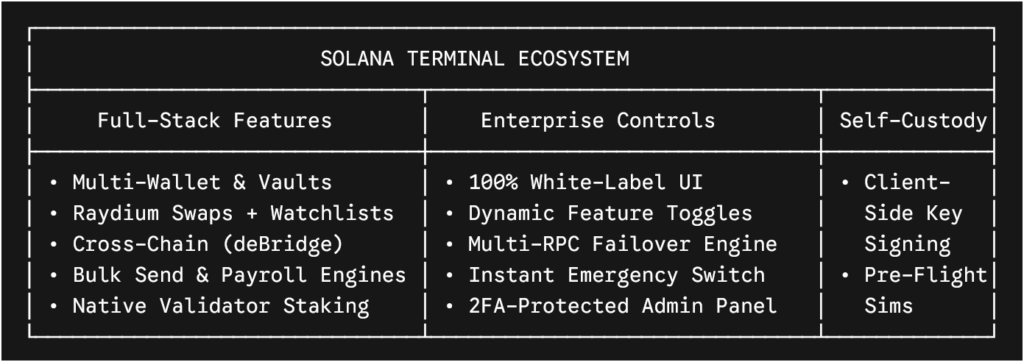
- True Self-Custody Without Compromise: Unlike custodial web apps or centralized tools, private keys and seed phrases never leave the browser. Everything is signed locally.
- Integrated Bulk Operations: Standard wallets restrict transactions to one recipient at a time. Solana Terminal natively supports bulk disbursements—allowing teams to pay out hundreds of addresses in a single, batched execution with variable, fixed, or randomized amount options.
- Pre-Flight Transaction Safety: Network fees and unexpected slippage shouldn’t cost you money on failed attempts. With real-time transaction simulation, every transfer or transaction is pre-checked against current on-chain conditions before signing.
- Multi-RPC Failover Infrastructure: Public and private RPC endpoints often choke during high-traffic network spikes. Solana Terminal features built-in fallback RPC routing with live ping tests, ensuring seamless failovers mid-session.
- Turnkey White-Label Engine: Deployment takes minutes. Web3 communities, DAOs, and crypto projects can strip away default branding, toggle specific modules on or off, set custom maintenance windows, and run their own branded platform on their own terms.
Architecture & Engineering Footprint
Stop bouncing between platforms.
Swap, bridge, stake, send in bulk, and manage your portfolio from one interface—hosted by us, or downloaded and run entirely by you.
There is a common misconception about modern hybrid applications: If it runs in a standard browser, it’s just a basic static script.
The truth is much more robust.
Solana Terminal is built on a high-throughput React component system, backed by a resilient Node.js micro-architecture, and served via optimized PHP routing environments.
- Frontend Engine: Built with modern React libraries for state synchronization, ultra-low input latency, and sub-second UI updates across live Raydium quotes and portfolio balances.
- Security Layer: Heavy local cryptographic computations—such as PBKDF2 key derivation (250,000 iterations) and AES-256-GCM encryption—run client-side without locking up the UI thread.
- Backend & Distribution: Designed to deploy instantly on standard server hardware without complex backend orchestrations, giving operators battle-tested uptime and low resource consumption.
– Robust and Battle Tested –
Built with React performance and battle-tested server simplicity, Solana Terminal gives Web3 projects an instant, white-labeled front-end for their entire community.
What Can Be Added: Ecosystem Expansion Possibilities
Solana Terminal is designed around a modular plugin architecture. The system is built to expand into every sector of modern decentralized finance:
- Automated Limit Orders & DCA Vaults: Integrating order book protocols to let users set non-custodial limit orders and automated Dollar-Cost Averaging (DCA) strategies.
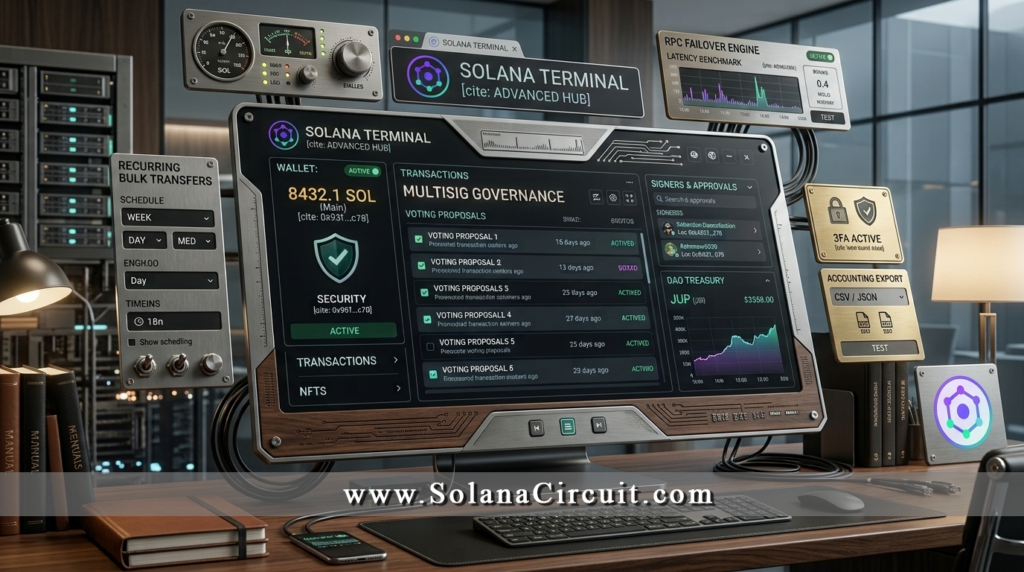
- Multisig Governance Modules: Direct integration with Squads protocol to allow multisig signers to execute bulk sends, swaps, and staking proposals directly inside the terminal.
- Advanced Portfolio Analytics & Tax Reporting: Automated gain/loss reporting, cost-basis tracking across all historic SPL transactions, and direct integration with major crypto tax exports.
- Meme Token & Launchpad Radar: A dedicated module tracking real-time liquidity pair launches, rug-check security scores, and instant snipe/trade capabilities.
- Hardware Wallet Integration: Extending browser-based standard connections to native Ledger, Trezor, and Keystone USB/Bluetooth hardware signing.
Strategic Product Roadmap
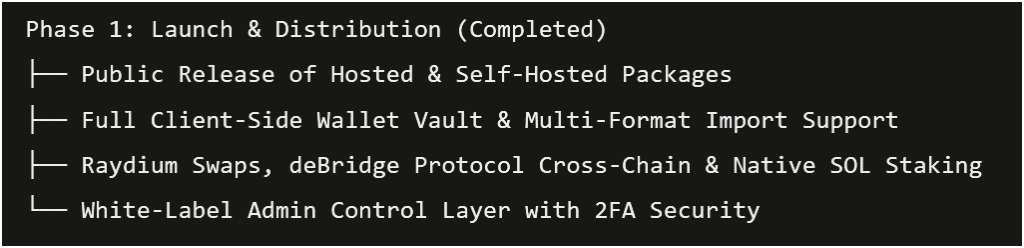
Phase 1: Launch & Distribution (Completed)
├── Public Release of Hosted & Self-Hosted Packages
├── Full Client-Side Wallet Vault & Multi-Format Import Support
├── Raydium Swaps, deBridge Protocol Cross-Chain & Native SOL Staking
└── White-Label Admin Control Layer with 2FA Security

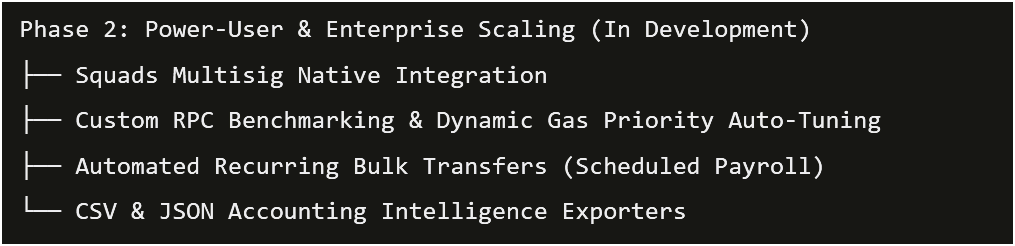
Phase 2: Power-User & Enterprise Scaling (In Development)
├── Squads Multisig Native Integration
├── Custom RPC Benchmarking & Dynamic Gas Priority Auto-Tuning
├── Automated Recurring Bulk Transfers (Scheduled Payroll)
└── CSV & JSON Accounting Intelligence Exporters

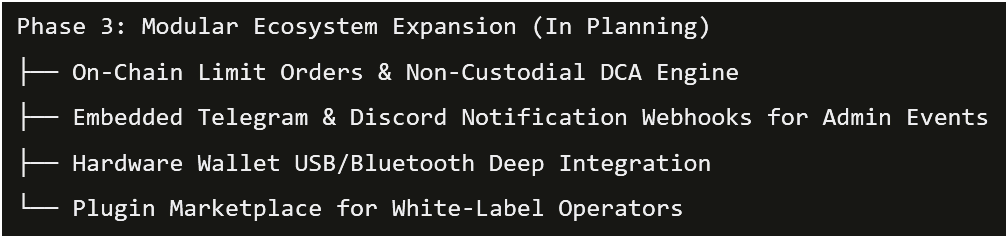
Phase 3: Modular Ecosystem Expansion (In Planning)
├── On-Chain Limit Orders & Non-Custodial DCA Engine
├── Embedded Telegram & Discord Notification Webhooks for Admin Events
├── Hardware Wallet USB/Bluetooth Deep Integration
└── Plugin Marketplace for White-Label Operators